


As an audio engineer, YouTuber, live streamer, or general content creator, you know that high-quality audio is an essential part of audience engagement and immersion. Whether you are recording a podcast, streaming a gaming session, or producing a video, the sound quality of your production can make or break your content. As a multimedia enthusiast or professional, having an accurate representation of audio is equally as important and can be quite challenging to achieve.
When listening or recording in an indoor environment, the room's shape, size, speaker placement & listening position, as well as sound treatments are all crucial factors to consider. Properly addressing each of these will have a large impact on audio quality and is often easier and cheaper than replacing gear. With these factors in mind, this article will provide a fun sound treatment solution for your room using Acoustic Panels you can make yourself. Before you start, consider the following...
Room Shape.
The shape and size of a room will drastically affect how sound waves eventually reach your ears. Walls and ceilings are reflective surfaces for sound waves and large unobstructed surface areas create the perfect opportunity for them to bounce all around the room. This behavior will play a major factor in what you hear. A great example is when you're in an empty room with no furnishings; you've probably noticed how sound echos and reverberates much more than when it is furnished.
When it comes to the acoustical properties for a room, a rectangular shape is often the best answer. You can actually refer to what is known as the golden ratio of 1H:16W:2.33L where 1 is the ceiling height, 1.6 is the width, and 2.33 is the length of the room. If you were to use this ratio in a room that has an 8' tall ceiling, the ideal width and length of this space would be 12.8' x 18.6'. Trying to select a room that is as close to these dimensions as possible will help mitigate the effects of standing waves and echos, but it will not eliminate them.
Standing waves are often found in frequencies below 300hz and are caused by sound waves bouncing between two or more surfaces (walls, windows, furniture, etc.) which can emphasize a specific frequency as the waves reinforce each other. In short, standing waves attribute to following acoustic problems in a room:
- Boosts in sound level and/or duration of a given frequency (resonance)
- Dips in sound levels at other frequencies.
Room Size.
In smaller rooms, low frequency sound waves are continuously reinforced by their own reflections due to their large oscillations. They are also less affected by sound absorbing material and have the most acoustic energy build up in the room. For this reason, larger rooms are almost always preferred!
Speaker Placement & Listening Position.
I know that most people do not have the luxury of building or much less choosing a room to listen in, but even if the shape and size of the room you're in isn't perfect you, can still optimize the space. A free and easy way to make an improvement is by re-arrange the furniture to accommodate a good listening position. Start with having your speakers along one of the short walls and if you have a choice between multiple short walls, place your speakers on the side opposite of where you can place various sound treatments.
This is a general guideline and not a rule set in stone, so experiment with your room to see what works best. For example, if a space is abnormally narrow you may have better results placing speakers along the long wall. Also, if your room has a window or large mirror that can't be removed, you'll likely want to have your speakers placed along a wall that faces away from these surfaces.

and listening position
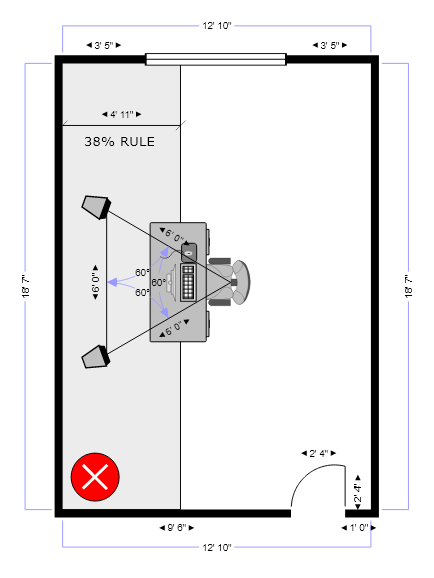
and listening position
Acoustic Panel benefits.
Now that you've sorted out the room, adding sound treatments such as acoustic panels to the walls and ceiling can be a relatively inexpensive yet effective way to improve overall audio quality. Adding sound treatments will help by reducing noise in the form of echo and reverberation through absorbing sound waves. They are often made of materials such as foam, fiberglass, or acoustic fabric and are typically designed to be placed on walls, ceilings, or floors.
Here's a list of reasons to use Acoustic Panels:
- Improved Sound Quality: Acoustic panels help to improve the sound quality of your recordings by reducing unwanted noise and echoes by significantly reducing the impact your indoor environment has on your recorded audio, making it sound clearer, uncolored, and more professional.
- Better Speech Intelligibility: If you are recording a podcast or video that involves dialogue, acoustic panels can help improve speech intelligibility by reducing echo and reverberation. This ensures that your listeners can hear and understand what you are saying.
- Reduction of Reflections: Acoustic panels help reduce reflections and echoes that can create an inaccurate representation of the sound. Reflections can cause phase cancellation and other interference that can lead to a distorted sound. Acoustic panels can help minimize these reflections and create a clear, accurate sound.
- Elimination of Standing Waves: Standing waves can occur when sound waves reflect back and forth between two surfaces in a room, such as walls or ceiling. This can cause certain frequencies to become exaggerated or canceled out, leading to an uneven frequency response. Acoustic panels can help eliminate these standing waves and provide a more accurate representation of the sound.
- Improved Frequency Response: Acoustic panels can help improve the frequency response of a room by reducing reflections and standing waves. This can help ensure that the sound you hear through your speakers is accurate and precise, without any distortions or inaccuracies.
- Noise Reduction: If you live in a noisy environment, acoustic panels can help reduce the amount of outside noise that enters your recording space. This can be particularly useful if you are recording audio or video content in a busy urban area.
- Increased Comfort: If you spend a lot of time listening to music or mixing sound, having a comfortable environment is crucial. Acoustic panels can help reduce the amount of noise in a room, making it more comfortable for extended listening sessions.
- Aesthetics: Finally, acoustic panels can also improve the aesthetics of your listening room. There are a variety of colors and designs available, so you can choose panels that match your decor or create a unique look.
How many should I make and where should I place them?
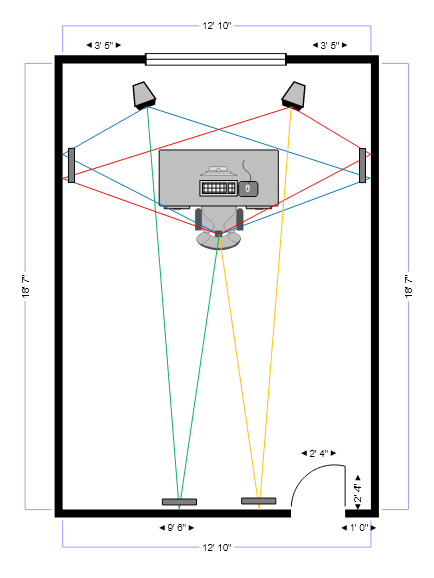
Consider making at least four (4) acoustic panels and placing them at the early reflection points around your room. Refer to the diagram below for an example.
Ready to make your own?
Check out the dimensional drawings I created for this project. Click on the photo below to view, print, or download the PDF file.

Here's what you'll need.
List of materials and tools coming soon! For now, feel free to download the completed dimensional drawings for this project which should be enough to get started.
Materials (please check back soon)
- Item 1
- Item 2
- Item 3
- etc.
Tools (please check back soon)
- Item 1
- Item 2
- Item 3
- etc.
Assembly Instructions
Step-by-step guide with photos coming soon. For now, feel free to download the completed dimensional drawings for this project which should be enough to get started.
Additional Research
You may also want to check out these articles which I believe are quite insightful and packed with additional information.
Sonarworks.com - How To Set Up Your Home Studio For The Best Sound
Musicgearzone.com - Best Room Shape For Acoustics and Home Recording